


Table of Contents
The iGaming industry has evolved into a highly competitive digital market where operators need reliable technology, engaging casino content, secure payment infrastructure, and efficient management systems. For businesses planning to enter the online gambling industry, one of the first decisions is choosing the right technology model for launching a casino.
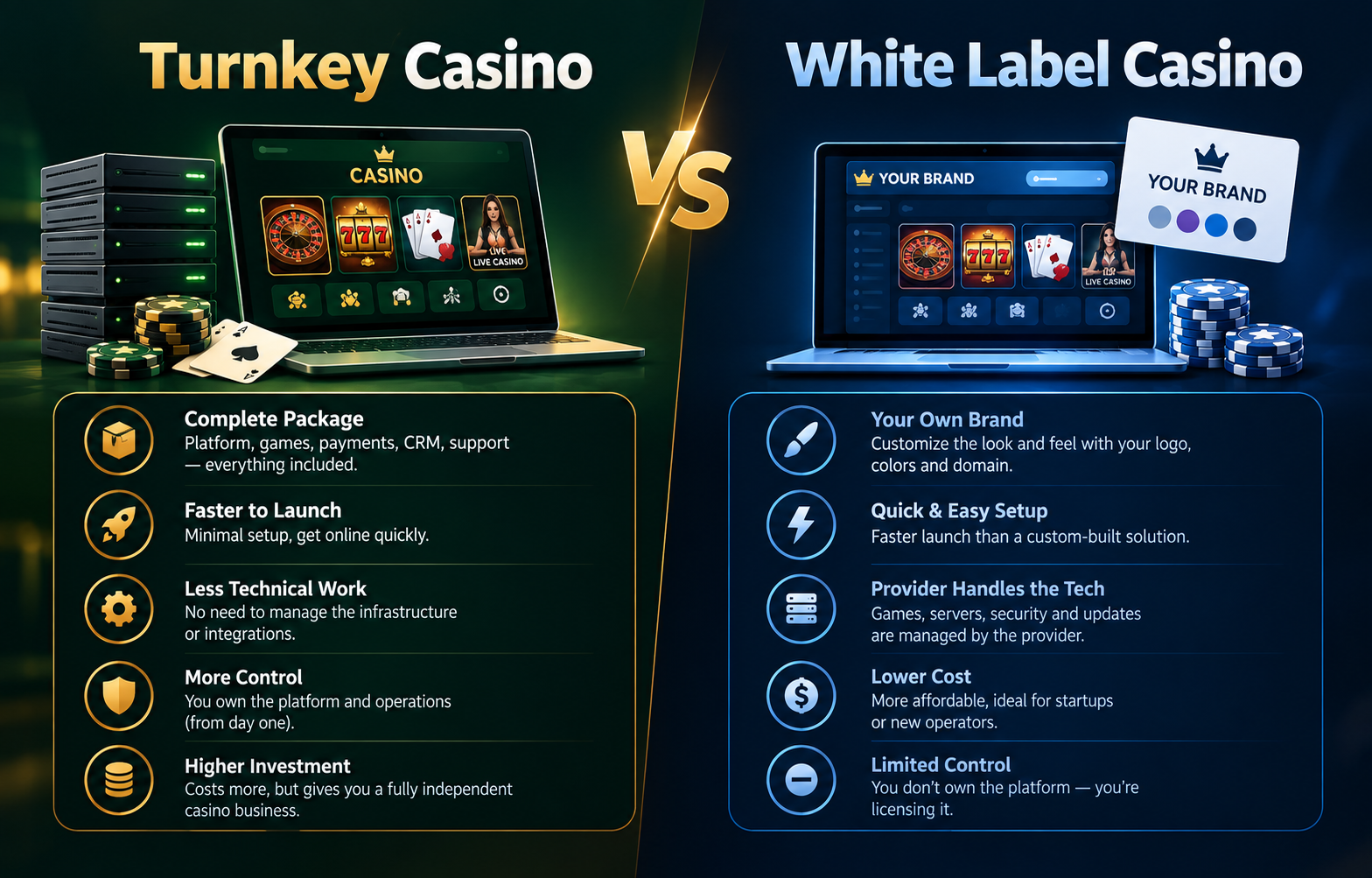
Two commonly considered options are a Turnkey casino solution and a White label casino. Although both models can help businesses launch an online casino faster than building an entire platform from scratch, they provide different levels of customization, ownership, infrastructure control, and operational flexibility.
Understanding Turnkey Solution vs White Label Casino solutions can help entrepreneurs, operators, and investors identify the technology model that aligns with their business objectives.
Future Grid Labs provides iGaming technology solutions designed for businesses looking to launch and scale online gaming operations. As an iGaming platform provider, Future Grid Labs focuses on providing technology infrastructure and solutions that can support casino and sportsbook businesses across different operational requirements.
What Is a White Label Casino?
A White label casino is a ready-made online casino platform that allows an operator to launch a casino business using an existing technology infrastructure. The technology provider generally handles major platform components, while the operator focuses more on branding, marketing, customer acquisition, and business development.
A white-label model can reduce the technical complexity involved in launching an online casino. Instead of developing a casino platform, payment system, back-office tools, and other infrastructure independently, an operator can use an existing platform and customize selected elements according to the available options.
Typical white-label casino features may include:
- Casino website and frontend
- Player registration and account management
- Casino game integration
- Payment gateway integration
- Back-office management
- Reporting and analytics
- Promotional tools
- Player management
- Security features
- Mobile-responsive interfaces
- Customer support infrastructure
The exact features and level of customization depend on the technology provider and commercial agreement.
What Is a Turnkey Casino Solution?
A Turnkey casino solution is a comprehensive technology package designed to provide the infrastructure required to operate an online casino. Rather than simply providing a branded platform, a turnkey model can involve a broader set of technical and operational components.
The objective is to give an operator a more comprehensive technology foundation while allowing greater control over different elements of the business.
Depending on the provider, a turnkey solution may include:
- Custom casino platform
- Casino games integration
- Payment integrations
- Player account management
- Admin dashboard
- CRM functionality
- Bonus management
- Reporting systems
- Security infrastructure
- API integrations
- Affiliate management
- Sportsbook integration
- Multi-language functionality
- Multi-currency support
- Technical maintenance
The scope varies between providers, so businesses should evaluate exactly what is included before selecting a solution.
Turnkey vs White Label Casino: Main Difference
The most important difference between Turnkey Solution vs White Label Casino solutions is the level of control and customization available to the operator.
A white-label solution is generally based on an existing platform that can be branded and configured for a particular business. This approach can simplify the launch process.
A turnkey solution can provide a broader technology foundation and may offer more flexibility for businesses that want to develop a differentiated platform.
The choice therefore depends on factors such as:
- Business model
- Available investment
- Desired customization
- Technical requirements
- Target markets
- Scalability requirements
- Control over technology
- Long-term product strategy
White Label Casino: Key Benefits
Faster Market Entry
One of the main reasons businesses consider a white-label casino is speed. Since much of the technology infrastructure already exists, operators can avoid lengthy platform development.
This can allow businesses to concentrate on branding, marketing, customer acquisition, and operational planning rather than building every technical component from the beginning.
Lower Technical Complexity
Developing an online casino independently requires expertise across multiple areas. These can include frontend development, backend infrastructure, payment processing, game APIs, security, databases, analytics, and system maintenance.
A white-label model reduces the amount of technology development that the operator needs to manage internally.
Ready-Made Infrastructure
Operators can gain access to an existing casino infrastructure instead of creating the entire technology stack themselves. This can be particularly useful for businesses entering the iGaming sector for the first time.
Branding Opportunities
Although the underlying platform may be shared or standardized, operators can generally apply their own branding elements, including logos, colors, domain names, content, and marketing identity.
White Label Casino: Potential Limitations
A white-label casino can also have limitations depending on the provider.
Customization may be restricted because the platform is based on an existing infrastructure. Businesses that require unique workflows, specialized integrations, or highly customized user experiences may need additional development.
There can also be limitations regarding technology ownership and control. Therefore, operators should carefully review platform access, integration options, commercial terms, scalability, and support arrangements.
Turnkey Casino Solution: Key Benefits
Greater Customization
A major advantage of a turnkey model can be the ability to build a platform around specific business requirements.
Instead of adapting completely to an existing standardized platform, businesses may have more opportunities to customize the user experience, backend workflows, integrations, and platform functionality.
Flexible Technology Integration
A turnkey solution can be suitable for businesses that need integrations with specific payment providers, casino game APIs, CRM systems, affiliate platforms, analytics tools, or other third-party services.
Scalability
Scalability becomes increasingly important as an online gaming business grows.
A suitable turnkey architecture can be designed to support increasing numbers of players, games, transactions, markets, and integrations. The actual scalability depends on the underlying technology architecture and infrastructure.
Greater Product Control
Businesses with a long-term technology strategy may prefer greater control over their platform environment.
This can be important for operators planning to develop unique features, introduce specialized products, integrate additional verticals, or create a distinct user experience.
Turnkey Casino Solution: Potential Considerations
A turnkey platform can require more planning than a standard white-label product.
Businesses may need to define their technical requirements, integrations, user journeys, branding requirements, payment infrastructure, game portfolio, and operational workflows.
The initial investment can also vary depending on the level of customization required.
For companies planning a long-term iGaming operation, however, the ability to create a technology environment around specific business needs can be an important consideration.
Turnkey vs White Label Casino: Cost Considerations
Cost is another important factor when comparing Turnkey vs White Label Casino solutions.
A white-label model can often reduce initial technology development expenses because the core platform is already available. However, businesses should evaluate the complete commercial structure rather than looking only at the initial launch cost.
Possible expenses may include:
- Platform fees
- Revenue-sharing arrangements
- Setup charges
- Payment processing costs
- Game integration costs
- Licensing-related expenses
- Marketing expenses
- Maintenance and support
- Additional customization
Turnkey solutions can involve higher initial development or setup costs when extensive customization is required. However, the cost structure may be different because businesses can have more control over the technology environment.
A detailed total-cost analysis should consider both initial investment and long-term operational expenses.
Technology and Customization Comparison
Customization is one of the most important areas to evaluate.
A white-label casino generally provides predefined functionality with configurable options. This makes the platform easier to deploy but can limit the extent to which the operator can change the underlying technology.
A turnkey solution can provide greater flexibility for custom development.
For example, a business may want:
- A unique casino lobby
- Customized player journeys
- Special promotional mechanics
- Custom reporting
- Specific payment integrations
- Proprietary CRM workflows
- Dedicated APIs
- Custom affiliate systems
- Multi-product integration
In such cases, a more customizable architecture may be relevant.
Games and Content Integration
Casino content is central to any online casino operation.
Both models can support casino games integration, but the exact process depends on the technology provider.
A platform may connect with multiple game suppliers through APIs or aggregation technology, allowing operators to offer different categories such as:
- Slots
- Live casino
- Table games
- Roulette
- Blackjack
- Baccarat
- Poker
- Crash games
- Specialty games
When evaluating a platform, operators should examine the available game portfolio, integration capabilities, content management tools, and geographic availability.
Payment Integration
Payment infrastructure is another important consideration.
Online casino platforms may require integration with multiple payment methods depending on the target market. These can include cards, bank transfers, digital wallets, alternative payment methods, and other locally supported options.
A reliable platform should provide appropriate tools for managing deposits, withdrawals, transaction monitoring, and payment-related workflows.
Businesses should also evaluate security, transaction processing, reporting, and compliance requirements before launching.
Scalability and Business Growth
A platform that works for a small launch may not necessarily be suitable for a rapidly expanding operation.
When comparing Turnkey Solution vs White Label Casino solutions, businesses should consider their expected growth.
Important questions include:
- Can the platform support additional players?
- Can new games be integrated easily?
- Can additional payment providers be added?
- Can new languages and currencies be introduced?
- Can sportsbook functionality be added?
- Can new markets be supported?
- Can the platform integrate with new business tools?
These questions can help businesses assess whether the selected technology can support their long-term plans.
Why Choose Future Grid Labs?
Future Grid Labs provides technology solutions for businesses operating in the iGaming industry.
As an iGaming platform provider, Future Grid Labs works around technology requirements for casino and sportsbook businesses, offering solutions designed to support different business models.
The company’s solution portfolio can include:
- White label casino solutions
- Turnkey casino solutions
- Casino platform development
- Casino games API integration
- Sportsbook platform solutions
- Payment integrations
- Custom iGaming technology
- API-based gaming infrastructure
- Back-office solutions
The right solution depends on the operator’s business model, target market, technology requirements, customization expectations, and growth strategy.
White Label or Turnkey: Which Model Fits Your Business?
There is no single model that applies to every iGaming business.
A white-label platform may be relevant for businesses that prioritize a faster launch, existing infrastructure, and reduced technical complexity.
A turnkey solution may be relevant for businesses that require more customization, greater technology control, specialized integrations, and a platform designed around their long-term requirements.
Before making a decision, businesses should evaluate:
1. Launch timeline: How quickly does the business need to go live?
2. Budget: What level of initial and ongoing investment is available?
3. Customization: How much control is required over the platform?
4. Technology: Which integrations and technical features are essential?
5. Scalability: How much growth is expected?
6. Market requirements: Which countries, languages, currencies, payments, and regulatory environments need to be supported?
7. Support: What level of technical assistance and maintenance is required?
Final Thoughts
Understanding Turnkey Solution vs White Label Casino models is an important step for businesses planning to enter or expand within the iGaming industry.
A white-label casino can provide an established technology framework that simplifies the launch process, while a turnkey casino solution can offer greater flexibility for businesses looking for a more customized technology environment.
The right approach depends on individual business requirements, budget, technical expectations, target markets, and long-term growth plans.
Future Grid Labs supports businesses with iGaming technology solutions, including White label casino, Turnkey casino solution, casino APIs, sportsbook platforms, and other technology services.
For businesses comparing different iGaming models, evaluating the platform’s technology, integrations, scalability, customization, support, and commercial structure can help create a clearer foundation for the next stage of development.